
OceanBase Unveils SeekDB: Bridging Hybrid Search and AI Workloads in a Unified Database

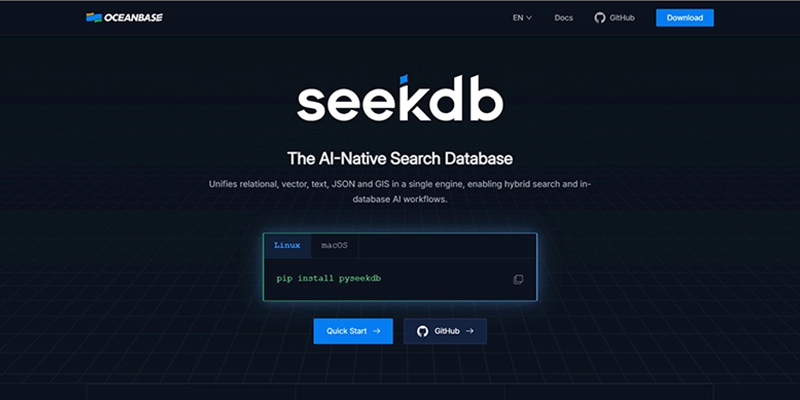
In an era where AI applications grapple with diverse data types from embeddings to geospatial records, how can developers streamline retrieval without juggling multiple systems?
Advancing AI-Native Databases for Multimodal Integration
SeekDB, a new open-source database released by OceanBase, emerges as a specialized tool designed for AI-driven workloads. Positioned as a lightweight, embedded variant of the OceanBase engine, it operates as a single-node system under the Apache 2.0 license, supporting embedded, client, and server modes while maintaining compatibility with MySQL drivers and SQL syntax. This design targets AI applications that require unified handling of relational data, vectors, text, JSON, and geographic information system (GIS) elements, potentially reducing the complexity of data pipelines in retrieval-augmented generation (RAG) and AI agent systems.
Unlike traditional setups that rely on separate OLTP databases, vector stores, and search engines, SeekDB integrates these capabilities into one storage and indexing layer. This unification could lower operational overhead for developers building AI systems, as hybrid queries can execute without external orchestration. The database inherits core features from OceanBase, including ACID transaction compliance, hybrid row-column storage, and vectorized execution, though it does not support distributed deployments—those remain the domain of the full OceanBase product.
Core Capabilities in Hybrid Search and Data Models
At the heart of SeekDB is its hybrid search functionality, which combines vector-based semantic retrieval, full-text keyword matching, and scalar filtering in a single query and ranking process. This is facilitated through the DBMS_HYBRID_SEARCH system package, offering two primary interfaces:
- DBMS_HYBRID_SEARCH.SEARCH: Returns results as JSON, sorted by relevance.
- DBMS_HYBRID_SEARCH.GET_SQL: Generates the underlying SQL string for execution.
- Relational data: Standard SQL for structured queries.
- Vector search: Handles dense and sparse vectors with metrics like Manhattan, Euclidean, inner product, and cosine distance; indexes include in-memory options (HNSW, HNSW SQ, HNSW BQ) and disk-based ones (IVF, IVF PQ).
- Full-text search: Features keyword, phrase, and Boolean queries with BM25 ranking and multiple tokenizer modes.
- JSON data: Dedicated indexes for metadata queries.
- Spatial GIS data: Indexes for range or polygon-based constraints.
Embedded AI Functions and Workload Implications
SeekDB extends its utility with in-database AI functions, enabling direct model invocations from SQL without intermediary application layers. Key functions include:
- AI_EMBED: Converts text to embeddings.
- AI_COMPLETE: Generates text using chat or completion models.
- AI_RERANK: Reorders candidate results.
- AI_PROMPT: Assembles dynamic prompt templates into JSON for AI_COMPLETE.
“SeekDB unifies vector search, full-text search, and relational filtering in a single SQL interface, enabling multi-signal retrieval for RAG and agent workloads without stitching multiple engines,” notes the project’s documentation on its design philosophy.
In comparison to broader market trends, the rise of AI-native databases reflects a shift toward integrated platforms, with open-source options like SeekDB potentially accelerating innovation in the $50 billion-plus database management systems sector (projected to grow at 12% CAGR through 2030, per industry analyses). By supporting Python integration via pyseekdb and compatibility with AI frameworks, it positions itself as a versatile data plane for emerging applications. What could unified hybrid databases like SeekDB mean for the future of AI development, particularly in democratizing advanced retrieval for smaller teams and edge computing?